VIN Lookup gives instant access to a vehicle’s 17‑digit VIN history, letting buyers see title status, accident reports, and recall alerts in seconds. By entering the VIN number into our online portal, you can decode manufacturer code, model year, and plant location, then pull a VIN record search that reveals ownership changes and mileage logs. This fast VIN search online removes guesswork and helps you verify a used car before purchase.
VIN Lookup also connects you to the state’s vehicle identification number database, where you can run a VIN decoder to check theft history, salvage titles, and active recalls. The system validates VIN format, flags invalid entries, and cross‑checks registration records for recent transfers. Whether you need to know how to find vehicle information by VIN or confirm mileage, this reliable VIN verification service streamlines the pre‑purchase decision.
How to Search VIN Lookup
VIN Lookup starts with the 17-character vehicle identification number and a trusted source that covers the records you need. A decoder can identify the maker, model year, and plant code, while title and history searches can reveal registration events, mileage readings, title brands, and reported incidents. Users can also check greenville county sc for official county government information. These records come from separate systems, so no single result always holds every fact. The steps below show how to submit a VIN, confirm the returned vehicle, and spot a partial or delayed record.
Official Search Portal: https://gcso.org/
Steps to Search
- Open the Greenville County Sheriff’s Office website and use its main menu or search field to locate a VIN, vehicle-records, or records-request path. Confirm that the page belongs to the official site before submitting personal details.
- Copy the full VIN from the driver-side door jamb, lower dashboard, or vehicle title. Read every character and keep the original source nearby for comparison.
- Compare the VIN at the door, dashboard, title, and registration document. Stop and correct the source if any label shows a different number.
- Paste the VIN into the portal’s VIN field without spaces or dashes. If the page has no direct VIN field, use the vehicle-record request form and enter the same number in its VIN box.
- Complete each required request field. A title or report request may ask for the plate, registration state, requester details, proof of ownership, or authorization.
- Submit the request and wait for the returned record. Review the source name, event dates, update dates, and any message stating that some data was unavailable.
- Match the returned make, model, model year, body style, and plant code with the vehicle labels. A mismatch needs review before the record supports a purchase decision.
- Save or print the result, including the search date. For federal recall checks, use the National Highway Traffic Safety Administration search listed later in this page.
Enter 17-Digit VIN
A modern North American vehicle carries one 17-character VIN, which is often called a 17-digit VIN in everyday use. Letters count as characters, so the number can contain both letters and numerals. Locate the VIN before entering a search request, and copy it directly rather than typing from memory.
- Driver-side door jamb: The label is often on the door frame or near the latch when the driver’s door is open.
- Lower dashboard: Many vehicles place a VIN plate at the far-left side of the windshield, where the driver can read it from the seat.
- Title and registration records: These documents may show the VIN in a box labeled VIN, Vehicle Identification Number, or serial number.
- Engine or frame area: Some vehicles carry a second VIN plate on the engine or frame. Use it as a cross-check because replacement parts can carry labels from another vehicle.
Do not use a license plate number as a substitute for the VIN. Plates can be changed, transferred, or reused, while the VIN stays with the vehicle. A VIN search also differs from a plate search because a plate can point to the current registration rather than the vehicle’s full history.
Validate VIN Format
Format checks catch many typing errors before a search reaches a records database. They do not prove that a vehicle has a clean title, accurate mileage, or no damage. A valid code can still belong to a vehicle with an unresolved record issue.
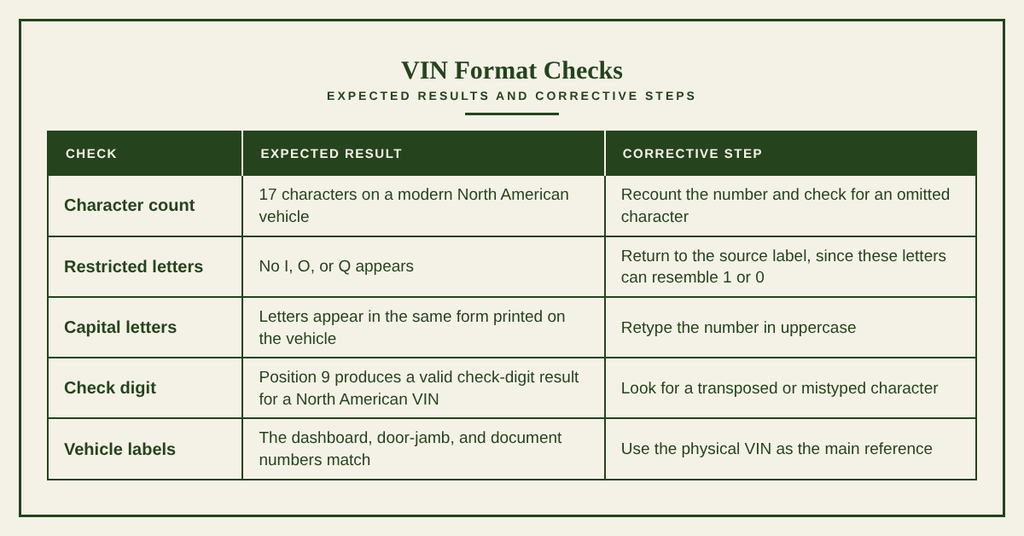
The official NHTSA VIN decoder at https://vpic.nhtsa.dot.gov/decoder/ offers a useful format test. Enter the number and compare its displayed maker, model year, and plant data with the vehicle labels. The ninth-position check digit can expose many entry errors, yet a successful decoder response does not certify title status, ownership, mileage, or physical condition.
Required Search Details
Most decoding and recall tools need only the VIN. Record requests can require more because title offices and law-enforcement agencies control access to protected files. Check the posted request rules before sending payment or identity documents.
- Vehicle identification number for the exact vehicle being checked
- Make, model, model year, plate number, and registration state as cross-check data
- Current title or registration document when the request form requires it
- Requester name, address, contact details, and identity proof when required by the source
- Proof of ownership or written authorization when a record belongs to someone else
- The record type needed, such as title history, registration history, mileage, theft, or law-enforcement records
Official federal decoding and recall tools do not require a paid vehicle-history package. State title requests and agency record requests can carry fees or eligibility rules, so read the current terms on the source page. Keep uploaded documents within a trusted government or agency system, and avoid sending title papers to an unfamiliar paid site.
VIN Structure & Decoding
VIN decoding works by reading each group of characters under an assignment system created by vehicle manufacturers and government agencies. The format is consistent across North American vehicles, yet the meaning of many codes changes by maker. The character map below gives the basic structure, while a maker-specific decode supplies the exact model and equipment details.
The first three VIN characters identify the manufacturer and country or region. Characters 4–8 describe vehicle attributes such as model, body, engine, or weight class. The 9th character is a check digit used to verify VIN accuracy in most North American vehicles. The 10th indicates the model year, the 11th identifies the manufacturing plant, and the final six characters represent the production sequence.
World Manufacturer Identifier
The World Manufacturer Identifier occupies positions 1 through 3. Its first character points to a broad geographic region, and the full group identifies the company or organization assigned to build the vehicle. North American assignments commonly use WMI groups beginning with 1, 2, or 3, with each code tied to a specific maker and manufacturing region.
A manufacturer can receive more than one WMI for different vehicle lines, plants, or product groups. Corporate name changes can also place a familiar vehicle badge under a different assigned code. For that reason, the WMI should be checked against the maker’s official decode rather than against a badge alone. It identifies the maker’s origin, not the vehicle’s title or condition.
Vehicle Descriptor Section
The Vehicle Descriptor Section occupies positions 4 through 8. These five characters can identify attributes such as model series, body configuration, engine type, weight class, restraint system, or a particular feature package. A maker creates its own code pattern, so the same position can carry different meanings for different brands.
Generic decoders often return only the fields that can be read with confidence. That limited result does not mean the remaining attributes are missing from the vehicle. For a used vehicle, compare decoded body, engine, and restraint fields with the door-jamb label, build sheet, and seller documents. A mismatch can come from a decoder limitation, a copied VIN, an altered vehicle, or a simple data-entry error.
Vehicle Identifier Section
The Vehicle Identifier Section covers positions 9 through 17. In a North American VIN, position 9 holds the check digit, position 10 holds the model year code, and position 11 holds the plant code. Positions 12 through 17 form the production sequence number used by the manufacturer.
The production sequence is unique within the maker’s applicable plant and model-year system, but the same characters may occur under another manufacturer. The VIN as a whole identifies one vehicle; one segment by itself cannot. Decoders rely on the manufacturer’s assignment records to connect the sequence number to a factory order and production run.
Model Year & Plant Codes
The model year code at position 10 uses letters and numerals in a repeating cycle. A code that appears in an older document can return in a later year cycle, so the model year needs context from the title, registration, and manufacturer records. The code also describes the manufacturer’s model year, which may differ from the calendar date when the vehicle was sold.
The character at position 11 is a plant code assigned by the manufacturer. It can point to an assembly plant or production operation, yet it may not provide a complete public address. Positions 12 through 17 identify the production sequence rather than the exact calendar day of manufacture. For a purchase, use the plant and year as supporting facts and confirm the identity through the remaining labels and title records.
Vehicle Specifications
Decoded vehicle specifications are factory assignments tied to the VIN. They do not test the vehicle’s present condition. Individuals can also check person lookup to verify relevant details. A seller can replace a part, alter a body panel, install a different engine, or post the wrong VIN, so every available field should be checked before money changes hands.
Make, Model & Year
The make, model, and model year offer the first identity checks for any used-vehicle VIN lookup. Compare the decoded values with the name shown on the title, registration, seller listing, and vehicle badges. A match supports identity, while a mismatch requires the seller to explain which label or record is wrong.
- Confirm that the maker’s name agrees with the WMI and the title.
- Compare the model name with the body label or build sheet.
- Check that the decoded model year agrees with the title and registration dates.
- Verify trim and package claims through a build record when the basic model matches but the options differ.
A VIN does not always distinguish every trim level or option on the first decode. An online listing may combine a valid model year with a higher trim than the VIN supports. That gap does not prove theft or a title problem, but it makes the build record or manufacturer production record necessary before accepting the price.
Body & Drive Type
Vehicle descriptor codes can reveal body style, cab or bed type, seating class, weight class, and drivetrain. These fields help detect a listing that describes a different vehicle. For example, a VIN assigned to a two-door body should not be paired with a four-door description without a record that supports the change.
Drivetrain labels such as front-wheel drive, rear-wheel drive, or all-wheel drive are useful for matching a VIN to a seller’s claim. A drivetrain badge or aftermarket conversion cannot replace the factory assignment by itself. Confirm unusual changes through receipts, inspection records, and the title history. A modified vehicle can remain legally titled, yet the modification can affect value, safety, warranty coverage, and future resale.
Engine & Transmission Details
Engine and transmission fields come from the vehicle’s assigned codes and manufacturer build data. A decoder may return engine type, cylinder count, displacement, fuel type, transmission style, and drive arrangement. Electric vehicles can show battery-electric or other powertrain codes instead of a combustion engine description.
A VIN decoder may identify the engine type, transmission, drive arrangement, and body class. Verify these details against the engine label, shift pattern, axle layout, door-jamb label, and manufacturer build records. Decoded information may not confirm the vehicle’s current equipment or condition.
An engine swap can leave the original VIN in place while changing the physical vehicle. That means a matching engine field can confirm the factory assignment without proving the current engine is original. Review receipts and inspection records for any visible mismatch between the VIN assignment and the components under the hood.
Vehicle History & Title Records
A VIN can connect to several kinds of history, yet each source records a limited set of events. A title service may know ownership transfers but not every repair. A police system may hold an accident report but not a complete service file. A recall database tracks safety campaigns rather than ownership or damage. Reading these boundaries prevents a partial report from being treated as a full vehicle history.
A VIN search may provide vehicle specifications, including make, model, year, engine, transmission, and manufacturing plant. Title and registration history may show title changes, registration periods, jurisdictions, and ownership-count changes, although older events or owner names may be unavailable.
Mileage records may include reported odometer readings, while accident and damage reports may identify recorded crashes or total-loss events. Theft records can show reported thefts or recoveries, and recall searches may identify open safety recalls and their remedies. Service history may be available through separate dealer or manufacturer records.
Registration & Ownership History
Registration history and title history are related but separate. A title event records the legal transfer of ownership, while a registration event ties a vehicle to a plate, registration period, and jurisdiction. A search may show the states connected to the vehicle, transfer dates, and the number of recorded owners without exposing every owner’s name.
Review the sequence rather than counting entries. A transfer across state lines, a title reissue after a name change, or an early registration can create extra records without indicating a problem. Gaps may reflect state record-retention rules, processing delays, or records held by another source. For a used car, ask for the most recent title and registration documents and compare their dates with the history report.
Accident & Damage Records
Accident and damage entries can come from police reports, insurance filings, inspection records, or total-loss title actions. An entry confirms that a report exists, not that the listed driver caused the crash. Some records state the location, damage estimate, and event type without giving a complete account of fault.
No accident entry does not establish that the vehicle never sustained damage. Minor repairs, off-road incidents, and some private settlements may never reach the searched database. For material damage, request the underlying police or insurer report and compare it with repair invoices, inspection records, and photographs. The vehicle’s current gaps, paint differences, and replaced parts can also support a physical inspection.
Salvage & Rebuilt Title Status
A title brand records a legal history rather than a permanent judgment about the vehicle’s present quality. The exact meaning depends on the issuing state and the law in force when the title was issued. Buyers should read the title itself, request its history, and confirm whether a repair or inspection record supports the branding.
A rebuilt vehicle can be safe, reliable, and correctly titled, but it has a different resale history from an original vehicle. Price that history instead of allowing a clean-looking photo to erase it. The title status and repair quality are separate questions, and each needs its own records.
Active Recalls & Theft Logs
Enter the VIN at https://www.nhtsa.gov/recalls to check open federal recall campaigns. A result can list the campaign number, affected components, defect description, remedy, and safety action. A vehicle may need a parts replacement, software update, inspection, or another correction. A closed campaign suggests the remedy was completed and the record updated, yet the manufacturer or dealer can confirm the work with the VIN.
No open federal recall means no campaign appeared in that federal search at the time checked. You can also consult address lookup to locate official filings. It does not cover every equipment issue, aftermarket part, local safety notice, or mechanical defect. The absence of a recall also says nothing about accident history or title status.
Theft logs use separate reporting systems and may include a vehicle reported stolen, a recovery event, or a later title transfer. An old theft entry does not prove that the vehicle remains stolen, and a missing entry does not prove it was never stolen. Confirm the current status with law enforcement, the insurer, and the state title record. For any report carrying legal weight, request the underlying case or certified record from its issuer.
Record Accuracy & Resolution
A VIN search can fail or return conflicting facts for many reasons. Most problems come from a mistyped character, an identity mismatch, delayed reporting, or different source dates. The correct response is to compare the records rather than pick the result that appears more convenient.
Invalid VIN Format Errors
Format errors occur before a complete record search. A count of 17 by itself does not guarantee a usable VIN, since copied text can contain the wrong letters, spaces, or characters from another vehicle. Use the diagnostic steps below to correct the entry.
If a VIN is too short or too long, recount the characters using the door-jamb or dashboard label. If a letter appears invalid, check whether I, O, or Q was mistaken for a number. Remove spaces, hyphens, and extra punctuation before searching. A check-digit failure may indicate a changed or misplaced character, so compare all 17 characters against the original labels. If the results identify a different vehicle, verify the make, model, year, and manufacturing plant.
If the VIN is not found, the vehicle may be new, imported, recently titled, or absent from the searched database. Try the appropriate source or contact the issuing agency for confirmation.
A valid 17-character VIN with no history can reflect a recently registered vehicle, an imported vehicle awaiting records, a database delay, or a source that does not hold that record type. It does not prove theft, title trouble, or a clean history. Confirm the physical VIN first, then query the agency or state that holds the needed file.
History Update Delays
Records move through separate workflows. A crash may reach a police database before an insurer submits a total-loss title. A title transfer may be complete at the state office before a third-party search vendor receives the change. A first registration for a new or imported vehicle can also take time to enter the systems used for VIN history searches.
No fixed update period applies to every event or source. A query can run at once while the underlying record remains behind. For recent events, check the event date, the source’s update date, and the date you ran the search. This prevents a newly filed record from being mistaken for one that never existed.
Read Each Record Date
Date labels answer different questions. Keeping them separate makes a delayed report easier to interpret. The event date indicates when the crash, transfer, registration, or other event reportedly occurred.
The filing date shows when the report or title document entered the filing process. The database update date identifies when the source refreshed the record, while the lookup date indicates when you searched and viewed the result.
Conflicting Database Details
Conflicting details often appear when two sources use different record dates or serve different purposes. A clean title report may lack a newly filed damage event, and two mileage records may refer to different filing dates. Review each field before deciding that one source is wrong.
Resolution Order for Disputed Records
Work from the physical vehicle toward the legal source. This order keeps a seller’s copy or a search summary from replacing the record that controls the legal status.
- Read the VIN from the driver-side jamb and dashboard, then confirm that both labels match.
- Compare the returned make, model, year, body, and plant code with those physical labels.
- Request the full title history from the state that issued the title and compare each dated transfer.
- Ask each report provider for its source, update date, and record identifiers behind a disputed entry.
- Compare the title, registration, insurance, repair, and inspection documents by date.
- Request the underlying police, insurer, or theft record when an event has legal or safety consequences.
- Keep the final records and search dates with the purchase file for later resale or insurance use.
Contact Details
- Address: Greenville County Sheriff’s Office 4 McGee Street Greenville, SC 29601
- Phone: (864) 271-5210
Office Hours: Mon-Fri: 8:30 AM – 5:00 PM
Frequently Asked Questions
Find clear answers about VIN Lookup, what data it returns, and how to use it for vehicle checks.
How does a VIN lookup work?
A VIN lookup starts with the 17‑character vehicle identification number. You enter the VIN into a trusted online portal or database. The system matches the code against records from manufacturers, state DMVs, and insurance companies. It then pulls details such as make, model year, plant code, and any reported events like title changes or accidents. Because the data comes from separate sources, a single report may not contain every fact, but it gives a solid snapshot of the vehicle’s history.
What info can a VIN decoder reveal?
A VIN decoder breaks the 17‑digit string into meaningful sections. The first three characters identify the world manufacturer identifier, showing the brand and country of origin. The next six characters describe the vehicle type, body style, engine, and model. The final eight digits include the model year, assembly plant, and a unique serial number. This breakdown helps you confirm the vehicle’s specifications and can flag mismatches that suggest tampering or errors.
How to check a vehicle title by VIN?
Enter the VIN into a title‑search service offered by state DMVs or reputable third‑party sites. The query returns the title history, showing if the car has a clean title, a branded title such as salvage or flood, or any lien holders. Some services also display the date of each title transfer. Reviewing this information before purchase helps you avoid cars with hidden problems or unresolved financial claims.
Why might a VIN not be found in the database?
A VIN may be missing for several reasons. New vehicles might not yet be entered into state or insurance records. Errors during VIN entry, such as transposed characters, can also prevent a match. In some cases, the vehicle was imported and the VIN was not registered with local authorities. If you encounter a “VIN not found” message, double‑check the number for accuracy and consider contacting the seller or the DMV for clarification.
Can I use a VIN lookup to spot a stolen car?
Yes, a VIN lookup can reveal theft reports recorded by police or insurance agencies. When you run the VIN, the report will list any theft or recovery incidents tied to that number. Some databases also flag vehicles listed on national stolen‑vehicle databases. While a VIN check is a strong indicator, it should be combined with a physical inspection and verification of ownership documents for complete assurance.